Note: PMS pricing is almost never published publicly—vendors quote custom prices based on practice size and negotiation. The ranges in this article come from community-reported figures on Dentaltown and dental Reddit threads—treat them as starting point estimates, not fixed prices.
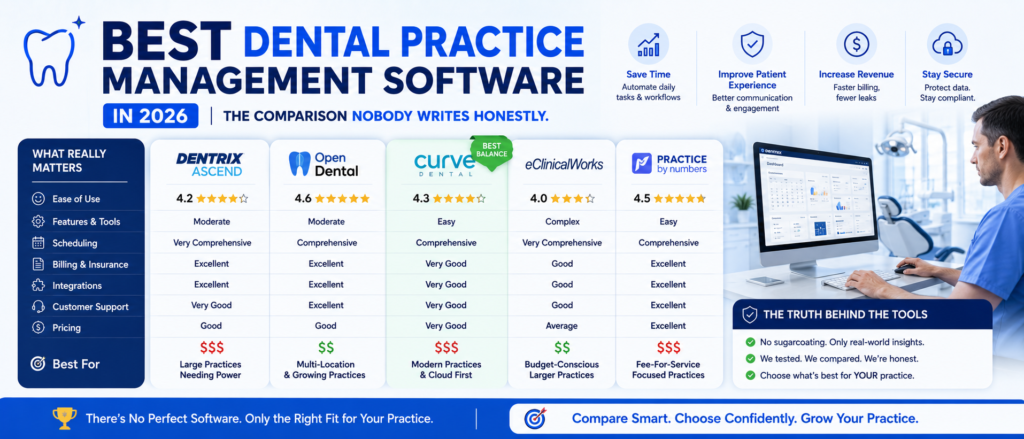
The 60-Second Verdict
Choosing dental practice management software is the most consequential technology decision a dental practice makes. Every other tool — your website, your booking widget, your patient communication platform — is downstream of your PMS choice. Get this wrong and you spend years working around a system that fights your workflow instead of supporting it.
Here is the straight answer based on practice type:
New practice starting from scratch with no existing ecosystem ties: do not choose Dentrix or Eaglesoft. Cloud-native platforms like Curve Dental, Archy, or CareStack offer modern architecture and often lower total cost of ownership for practices with no legacy data to migrate. Curve Dental, specifically, is the right starting point—browser-based, no server to maintain, and NexHealth integrates directly with it in real time.
Established practice already on Dentrix with Henry Schein supply relationships: stay on Dentrix unless you have a specific unmet need that justifies migration costs. Dentrix gets the slight edge in 2026 primarily because of the Ascend cloud path, built-in AI diagnostics through Detect AI, and deeper insurance automation.
Established practice already on Eaglesoft with Patterson supply relationships: stay on Eaglesoft unless imaging integration breadth beyond the Patterson ecosystem is a priority. Eaglesoft wins on imaging integration for Patterson-centric offices with over 50 imaging technologies supported natively.
Practice evaluating both Dentrix and Eaglesoft with no existing ecosystem: if you are choosing between them, you are really choosing between ecosystems—Henry Schein for Dentrix versus Patterson Dental for Eaglesoft. Choose neither if you are starting fresh with no ecosystem ties.
Multi-location practice or DSO: Open Dental is the top choice for multi-location practices. A dentist on Dentaltown stated that Open Dental is affordable and easy to use, and if you have multiple locations, it is a must-have.
Why This Decision Is More Complex Than Any Comparison Chart Shows
Every dental PMS comparison article ranks software on features, price, and ease of use. Those metrics are relevant, but they miss the factor that determines whether a PMS choice creates value or pain over a five- to ten-year practice lifecycle: ecosystem lock-in.
Dentrix is owned by Henry Schein. Eaglesoft is owned by Patterson Dental. Both companies are dental supply distributors whose primary revenue comes from selling supplies, equipment, and consumables to dental practices. Their PMS software is deeply integrated with their supply ecosystems—meaning practices that buy through Henry Schein get better Dentrix support, and practices that buy through Patterson get better Eaglesoft support.
Eaglesoft has a deep Patterson ecosystem tie-in—switching imaging hardware or supplies away from Patterson can create support friction. The same dynamic applies to Dentrix and Henry Schein.
This is not a criticism—both companies deliver reliable software, and the ecosystem integration provides genuine value. But it means that choosing Dentrix or Eaglesoft is not purely a software decision. It is a decision about which supply chain relationship you want to anchor your practice to for the next decade.
For a practice starting fresh in 2026 with no existing supply relationships, this ecosystem anchor is a reason to seriously evaluate cloud-native alternatives before defaulting to the two most familiar names.
The Five Platforms That Matter in 2026
Dentrix — The Industry Default For Established Mid-to-Large Practices
Dentrix is the most widely used practice management software in North American dentistry. It has been around since the late 1980s and has grown into a deeply featured platform covering scheduling, billing, clinical charting, imaging integration, patient communication, and reporting. It runs on-premises, meaning your data lives on a server in your office and the software is installed on each workstation.
The honest assessment for 2026: Dentrix is a mature, feature-rich platform that does everything a general or specialty practice needs. The interface shows its age — it was designed for desktop workflows in an era before cloud computing — but the depth of functionality is genuine.
Dentrix provides Reserve with Google integration for direct booking from Google Business listings plus appointment analytics that track booking behavior and no-show trends. For a practice focused on reducing no-shows and understanding booking patterns, this built-in analytics capability has real value.
The Detect AI feature—Dentrix’s built-in AI diagnostic tool—is the most significant recent addition. It analyzes radiographs and flags potential pathology for dentist review. For practices that have adopted digital radiography comprehensively, this AI layer adds genuine clinical value without requiring a separate subscription to a third-party AI diagnostic tool.
NexHealth integration with Dentrix: full real-time sync available. LocalMed integration with Dentrix: full real-time sync available. This means your website booking widget connects directly to your Dentrix schedule—patient bookings appear in Dentrix automatically without front desk intervention.
Pricing: custom quoted through Henry Schein sales. The typical range for a single-location general practice is $300-700/month, including software, support, and updates.
Ideal for: Established single and multi-location practices in the Henry Schein supply ecosystem. Practices that need depth of clinical features. Practices planning to migrate to Dentrix Ascend cloud when ready.
Eaglesoft — The Right Choice for Patterson-Centric Practices
Eaglesoft is Patterson Dental’s flagship practice management platform and Dentrix’s closest competitor in terms of market share. It is an on-premise Windows application covering scheduling, clinical charting, billing, and imaging integration. Eaglesoft has a clean, approachable interface, and many practices find the learning curve shallower than Dentrix. Patterson customer service tends to have a better reputation than Henry Schein’s for responsiveness.
The honest differentiator from Dentrix: Eaglesoft wins on imaging integration for Patterson-centric offices, while Dentrix offers a broader third-party marketplace and more granular reporting. For practices outside the Patterson supply chain, that advantage narrows considerably.
The honest limitation in 2026: the absence of a cloud roadmap is a strategic consideration. Dentrix has Dentrix Ascend as its cloud migration path. Eaglesoft has no equivalent announced cloud-native successor. For a practice that plans to expand to multiple locations or wants to move away from maintaining an on-premise server, this matters.
NexHealth integration with Eaglesoft: full real-time sync available. LocalMed integration with Eaglesoft: full real-time sync available.
Pricing: custom-quoted through Patterson Dental sales. Comparable range to Dentrix at $300-700/month.
Ideal for: Established practices in the Patterson supply ecosystem. Practices where imaging integration breadth across Patterson-compatible hardware is the priority. Practices where front desk staff already trained on Eaglesoft.
Curve Dental — The Right Choice for New Practices in 2026
Curve Dental was built in the cloud from the beginning—not adapted into it later. This architectural difference matters more than any feature comparison. A cloud-native system means no server to purchase, no server to maintain, no IT contractor to call when the server fails at 7:45am before a full morning schedule, and access from any browser on any device without VPN configuration.
For a practice starting fresh in 2026, the question of whether to invest in an on-premise server infrastructure to run Dentrix or Eaglesoft versus starting on a cloud-native platform that works from any browser is a question with a clear answer. The on-premise server represents a capital expenditure of $5,000-15,000 plus ongoing IT maintenance costs. Curve Dental eliminates that entirely.
NexHealth integration with Curve Dental: full real-time sync — one of Curve’s strongest integration partnerships. This makes the website booking setup described in our previous articles straightforward on Curve.
Pricing: transparent published pricing starting at approximately $400-600/month for a single-location practice, including all core features.
Ideal for: New practices launching without legacy data. Practices frustrated with on-premise server maintenance. Practices planning multi-location expansion where cloud access across locations is essential.
Open Dental — The Right Choice for Budget-Conscious Practices
Open Dental is the only major dental PMS that is genuinely open source. This means the core software is free — you pay for support, hosting, and any add-on modules you need. For a practice with technical in-house capability or a trusted IT partner, Open Dental delivers enterprise-level functionality at a fraction of the cost of Dentrix or Eaglesoft.
A dentist on Reddit recommended Open Dental, saying it is pretty user-friendly and that having used Dentrix, Eaglesoft, and SoftDent previously, Open Dental is their favorite. A dentist on Dentaltown said Open Dental is affordable and easy to use, and if you have multiple locations, it is a must-have.
The honest limitation: open source means self-managed. Practices without technical support resources will spend more time troubleshooting than a supported commercial platform requires.
NexHealth integration with Open Dental: full real-time sync available. LocalMed integration with Open Dental: full real-time sync available.
Pricing: The software is free. Support contracts from $199/month. Hosting if cloud-based is $100-200/month additional.
Ideal for: Multi-location practices where cost efficiency at scale is the priority. Tech-forward practices with IT support capability. Practices with tight budgets that need full-featured PMS functionality.
CareStack — The Best for Patient Experience Focus
CareStack is rated best for patient experience among dental PMS platforms in 2026. It is a cloud-native platform that combines practice management with patient engagement tools—automated recall, two-way texting, online forms, and reputation management—in a single subscription rather than requiring separate tools for each function.
For a practice currently paying separately for a PMS, a patient communication tool like Weave or Lighthouse 360, and a reputation management platform, CareStack’s all-in-one model can deliver cost savings while reducing the number of vendor relationships to manage.
NexHealth integration with CareStack: available. The combination of CareStack’s built-in patient communication tools with NexHealth’s real-time booking provides a comprehensive patient acquisition and retention stack.
Pricing: custom-quoted. Typically $400-800/month for a single-location practice, including all integrated features.
Ideal for: Practices that want to consolidate PMS and patient communication into one platform. Practices focused on patient retention and automated recall workflows. Growing practices that want to reduce the complexity of managing multiple vendor relationships.
| Platform | Type | NexHealth | LocalMed | Pricing/Month | Best For | Cloud Option |
|---|---|---|---|---|---|---|
| Dentrix | On-premise | Full sync | Full sync | $300-700 | Established Henry Schein practices | Dentrix Ascend (migration path) |
| Eaglesoft | On-premise | Full sync | Full sync | $300-700 | Patterson-centric practices | No cloud roadmap |
| Curve Dental | Cloud-native | Full sync | Full sync | $400-600 | New practices — no server needed | Native cloud |
| Open Dental | On-premise or cloud | Full sync | Full sync | $199-500 | Multi-location budget-conscious | Self-hosted cloud option |
| CareStack | Cloud-native | Available | Limited | $400-800 | Patient experience focus | Native cloud |
| Dentrix Ascend | Cloud | Full sync | Full sync | Custom | Dentrix practices moving to cloud | Native cloud |
The Migration Question — When to Switch and When to Stay
This is the question dental office managers ask most frequently in community forums, and it deserves a direct, honest answer.
Stay on your current PMS if: Your team knows it well; it integrates with NexHealth or LocalMed for website booking; your supply relationships are functioning correctly; and you have no specific unmet workflow need that your current system cannot address. Migration costs — in staff time, data transfer, retraining, and temporary productivity loss — are significant. Switching PMS platforms because a newer option looks interesting is rarely worth those costs.
Consider switching if you are maintaining an on-premise server that is approaching end-of-life and facing a $10,000+ replacement cost; your current system does not integrate with the booking tools your patients expect; you are expanding to multiple locations where cloud access is becoming essential; or your current vendor’s support quality has declined to a point where unresolved issues are affecting clinical operations.
The specific migration scenario where switching is clearly justified: a practice on an end-of-life server running Eaglesoft or an older version of Dentrix, facing a server replacement cost of $8,000-15,000, evaluating whether to invest in new on-premise infrastructure versus migrating to Curve Dental or CareStack at $400-600/month with zero server costs. In this scenario the cloud migration pays for itself within 18-24 months purely on avoided hardware costs.
What Office Managers on Dentaltown and Reddit Actually Say
The community consensus across hundreds of Dentaltown threads and dental subreddit discussions in 2025 and 2026 shows clear patterns that no vendor comparison chart captures.
Dentrix users report the deepest feature set and the most frustrating support experience. The consistent complaint is long hold times and inconsistent resolution quality from Henry Schein support. The consistent praise is that Dentrix does everything—if a workflow exists in dentistry, Dentrix has a feature for it.
Eaglesoft users report the most positive support experiences and the cleanest interface among the on-premise options. The consistent concern in 2026 threads is the lack of a clear cloud roadmap—practices thinking about long-term infrastructure are asking where Eaglesoft goes from here.
Curve Dental users report the highest satisfaction among practices that made the cloud migration. The consistent theme is relief at eliminating server maintenance. The consistent criticism is that the feature depth does not yet match Dentrix for highly complex multi-specialty workflows.
Open Dental users report the highest satisfaction among budget-conscious multi-location practices. The consistent theme is that the open-source model gives them control that no commercial vendor provides.
These questions came directly from Dentaltown forums and dental subreddit discussions—real decisions real practices are working through right now
Frequently Asked Questions From Dental Office Managers
We are on Dentrix and considering switching to Curve Dental. What does migration actually involve?
A full PMS migration involves exporting your patient records, treatment history, financial records, and imaging data from Dentrix—working with your Dentrix data vendor for the export—and importing them into Curve Dental using their migration team. Curve provides a dedicated migration specialist for practices switching from major PMS platforms. The process typically takes 4-8 weeks from decision to go-live. The practical consideration is running both systems in parallel for 30 days after go-live to ensure data integrity before fully decommissioning Dentrix. Budget 40-60 hours of staff time across the migration period for data verification and retraining.
Does our PMS choice affect which booking tool we can use on our website?
Directly, yes. NexHealth integrates in real time with Dentrix, Eaglesoft, Open Dental, Curve Dental, and CareStack. LocalMed integrates with Dentrix, Eaglesoft, Open Dental, and Curve Dental. If your PMS is not on the supported integration list for NexHealth or LocalMed, your website booking widget cannot sync with your live schedule in real time. This is a critical evaluation criterion for any practice adding online booking to their website. Confirm PMS compatibility with your chosen booking tool vendor before committing to either.
Is Open Dental genuinely free, or are there hidden costs?
The core Open Dental software is genuinely free to download and use. The realistic cost structure for a practice that wants proper support and cloud hosting is a support contract at $199/month, cloud hosting if you do not want an on-premise server at $100-200/month, and eServices add-ons for automated reminders and online forms at $50-100/month additional. Total realistic cost of $350-500/month—significantly less than Dentrix or Eaglesoft at equivalent feature levels, but not zero as the free software headline suggests.
Our practice is growing from one to three locations. Which PMS handles multi-location best?
For growing multi-location practices, Dentrix and Eaglesoft rank above alternatives. Proven multi-location management capabilities are critical at this growth stage. However, cloud-native platforms like Curve Dental and CareStack are increasingly the preferred choice for new multi-location builds because cloud access across locations eliminates the VPN and server synchronization complexity that on-premise systems require for multi-site deployments.