I went through both sales processes for a two-location practice and got the contract language in writing from each—here’s what actually mattered. Let’s deep dive into the comparison of Birdeye vs Podium fro dentists
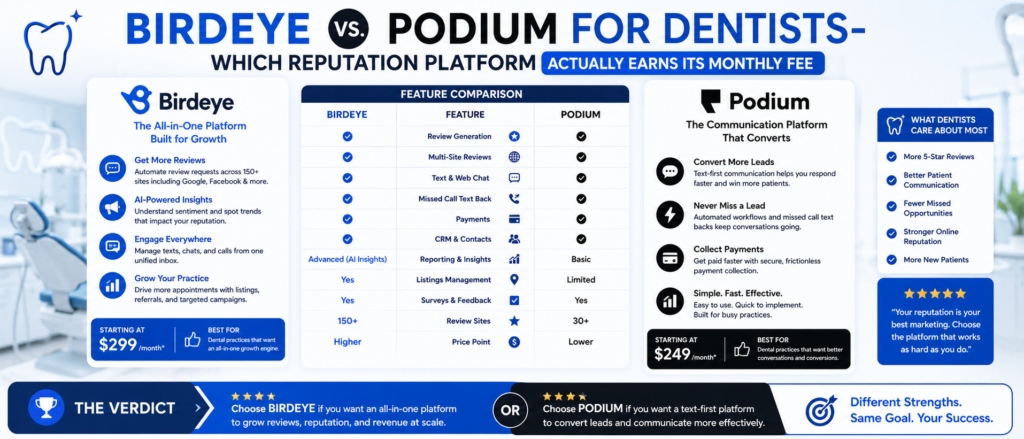
The 60-Second Verdict: Birdeye vs Podium for dentists
If you run a single-location or small dental practice and your #1 goal is more Google reviews via SMS, Podium is the lighter, cheaper entry point—it starts around $249/mo for up to 2 locations, and its text-first review requests convert well. If you’re a multi-location group or DSO that needs centralized reporting, listings management across 200+ sites, and deeper PMS integration (Dentrix, Eaglesoft, or Open Dental), Birdeye scales better—but you’ll pay $299–$449/mo per location and sit through a sales call to get a real number.
Both sign a BAA. Both are HIPAA-capable. Both will lock you into a 12-month auto-renewing contract that real users describe as painful to exit. That last point is the one nobody puts in the sales deck, and it’s the single biggest reason dentists end up frustrated. Read the cancellation clause before you sign — not after.
Bottom line: Podium for solo-practice review velocity on a budget. BirdEye for multi-location scale and reporting. Neither is “set it and forget it,” and neither contract is friendly. Negotiate the term length and get the cancellation process in writing.
Why Reputation Software Matters for Dentists Specifically
Dental is one of the most review-sensitive local categories there is. Patients compare-shop providers the same way they shop restaurants—they scan your star rating, read your three most recent reviews, and check whether you bothered to respond to the angry one. Industry data cited across the reputation-management space puts the share of patients who read online reviews before booking in the high-90s percent range, and practices that slip below roughly 4.2 stars on Google start losing new patients before the phone ever rings.
The mechanism both Birdeye and Podium sell is the same: automatically text or email patients after their appointment asking for a review, route happy patients to Google, and surface negative feedback to your front desk before it goes public. Practices that automate post-appointment review requests commonly report large jumps in monthly Google review volume—vendor benchmarks throw around 300–500% increases—though take vendor-sourced numbers with a grain of salt.
The reason this is a dental-specific purchase and not a generic-marketing-tool purchase comes down to two things: PMS integration and HIPAA. A reputation tool that doesn’t talk to your practice management software means your front desk is manually exporting patient lists, which nobody will do consistently. And because you’re triggering messages off of appointment data — which is protected health information — the vendor has to be a willing HIPAA business associate. That’s where a lot of generic tools quietly disqualify themselves.
HIPAA: Both Sign a BAA, But That’s the Floor, Not the Finish Line
Here’s the part that trips up dentists. A dental office is a covered entity under HIPAA, and the obligations don’t scale down for a three-operatory solo practice. The moment a reputation platform touches your appointment data to send a review request, it’s handling PHI on your behalf—which means you need a signed Business Associate Agreement (BAA) before any patient data flows.
The good news: both Podium and Birdeye will sign a BAA, and both market directly to healthcare and dental practices. Podium explicitly enters into a BAA with customers handling PHI and lists dental offices as a target market. Birdeye lists Dentrix, Eaglesoft, and Open Dental among its integrations and runs a dedicated dental product.
But signing the BAA is the floor. A few things dentists routinely miss:
- A BAA doesn’t make your use compliant. If your team texts a patient’s treatment details through the platform’s open SMS inbox or posts a before-and-after photo without separate written authorization, that’s on you—not the vendor.
- You still need a BAA with every other vendor in the chain—your IT company, cloud backup, and billing service. The reputation tool is one box on a long checklist.
- 2026 added new wrinkles. Practices have had to update their Notice of Privacy Practices for new substance-use-disorder confidentiality rules (Feb 16, 2026 deadline), and MFA mandates make shared front-desk logins a liability. If your whole team logs into the reputation dashboard with one shared password, you’ve undermined your audit trail.
The practical takeaway: don’t treat “they sign a BAA” as the end of due diligence. Treat it as the prerequisite that gets the vendor onto your shortlist.
Podium: Best for Single-Location Review Velocity
Podium built its dental business on SMS-first communication, and the product reflects that origin. Its core strength isn’t really reputation management in isolation — it’s the omnichannel layer around it: text-to-pay, webchat that converts site visitors into texted leads, and a unified inbox that combines SMS and social messages. For a solo practice that wants more Google reviews and two-way texting with patients, that’s a coherent, easy-to-use package.
Where Podium fits: Single-location practices and small groups prioritizing pure Google review velocity on a tighter budget. Entry pricing starts lower than Birdeye — around $249/mo for up to two locations — though the Pro plan (around $599/mo) caps at five locations, which makes it awkward for a group that’s actively expanding.
The catch: Podium runs 12-month annual contracts with auto-renewal, and contract cancellation is its most documented complaint — the company carries a D- BBB rating as of 2026 driven primarily by cancellation difficulties. Capterra reviews are genuinely mixed: plenty of 4–5 star users who love the all-in-one inbox, alongside blunt one-star reviews calling the billing and customer service predatory. The satisfaction is real for the right use case; the frustration clusters around getting out.
Birdeye: Best for Multi-Location Groups and DSOs
Birdeye is the more feature-deep platform of the two. Beyond review management, it covers listings sync across 200+ directories, customer surveys, AI sentiment analysis that flags recurring complaint themes, social management, and a unified inbox. For a DSO or multi-location group, the killer feature is the centralized dashboard that lets leadership compare review performance across locations while each local team manages its own engagement.
Where Birdeye fits: Multi-location dental groups and DSOs that need enterprise reporting and have someone on staff to actually run the platform. In G2’s healthcare data, Birdeye scores strongly on review generation (around 4.7/5) but noticeably lower on healthcare-specific integration (around 3.9/5)—a reminder that a “powerful generic tool” and a “dental-native tool” aren’t the same thing.
Pricing reality: Birdeye doesn’t publish prices; you’ll book a sales call. Real-world figures land at roughly $299/mo (Starter), $349/mo (Growth), and $449/mo (Dominate)—per location, billed annually. Add setup fees ($500–$3,000), possible SMS carrier charges, and an 8% “innovation fee” at renewal, and budget meaningfully above the headline number. The per-location model means a 5-location group on the mid-tier is writing a four-figure monthly check.
The catch: Same story, different logo. Annual contracts are standard, and Birdeye’s Trustpilot average sits around 3.8, with a recurring complaint pattern of difficult cancellations and unresponsive account management after onboarding. One representative 2026 review described months of unanswered cancellation requests while the company kept attempting to bill the card.
The Thing Both Vendors Bury: The Contract
This is the part worth slowing down for, because it’s the most consistent signal across every independent source. Both platforms use 12-month auto-renewing contracts, and both have a well-documented reputation for making cancellation hard. Podium’s D- BBB rating and Birdeye’s sub-4 Trustpilot average are driven by the same root cause—customers who found it far easier to sign up than to leave.
This isn’t a reason to avoid both. It’s a reason to negotiate before you sign:
- Push for a 1-year initial term, not a 2-year, so you have an exit ramp if it underdelivers.
- Get the cancellation process in writing — the exact notice window (often 60–90 days) and who you have to email.
- Confirm setup fees and renewal escalators up front, in the contract, not on the sales call.
- Read the auto-renewal clause and calendar the cancellation deadline the day you sign.
A vendor that’s confident in its product won’t fight you on reasonable contract terms. The ones that do are telling you something.
Quick Comparison
(See table below for the full feature-by-feature breakdown.)
The short version: pick Podium if you’re one or two locations, want SMS-driven Google reviews, and want the lower entry price. Pick Birdeye if you’re a multi-location group that needs centralized reporting and listings management and can staff someone to run it. Whichever you choose, the contract — not the feature list — is where dentists get burned, so that’s where your attention belongs.
| Feature | Podium | Birdeye |
|---|---|---|
| Best for | Single-location & small practices | Multi-location groups & DSOs |
| Core strength | SMS-first review velocity + unified inbox | Listings + centralized multi-location reporting |
| Entry pricing | ~$249/mo (up to 2 locations) | ~$299/mo per location (Starter) |
| Mid-tier pricing | ~$599/mo Pro (caps at 5 locations) | ~$349/mo per location (Growth) |
| Top-tier pricing | Custom | ~$449/mo per location (Dominate) + custom above 4 |
| Pricing published? | Partially | No — sales call required |
| Setup/onboarding fees | Varies | ~$500–$3000 |
| Renewal escalator | Varies | ~8% innovation fee at renewal |
| Signs a BAA (HIPAA) | Yes | Yes |
| PMS integrations (Dentrix/Eaglesoft/Open Dental) | Available — confirm version | Listed (3000+ integrations) |
| Listings management | Limited | 200+ directories |
| Contract term | 12-month auto-renew | 12-month auto-renew |
| Cancellation reputation | D- BBB rating (2026) | ~3.8 Trustpilot avg; cancellation complaints |
| Free trial | Demo-based | 30-day limited trial |
FAQ
Is Podium or BirdEye HIPAA-compliant? Both will sign a business associate agreement, and both market to dental and healthcare practices. Signing the BAA is necessary but not sufficient—your own usage (what you text, what photos you post, and whether you use shared logins) determines whether your practice stays compliant.
Which is cheaper for a single-location dental office? Podium, generally, its entry pricing starts around $249/mo for up to two locations versus Birdeye’s roughly $299/mo per location. BirdEye’s advantage only appears at a multi-location scale.
Do they integrate with Dentrix, Eaglesoft, or Open Dental? Birdeye lists all three among its integrations. Confirm your specific PMS and version with either vendor before signing, since integration depth varies and is the single biggest predictor of whether the tool actually gets used.
Can I cancel easily? This is the most common complaint for both. Expect a 12-month auto-renewing term and get the exact cancellation window and process in writing before you sign.
This article is general information, not legal or compliance advice. Verify current pricing, BAA terms, and integration support directly with each vendor, and consult a HIPAA compliance professional for your specific practice.