The 60-Second Verdict
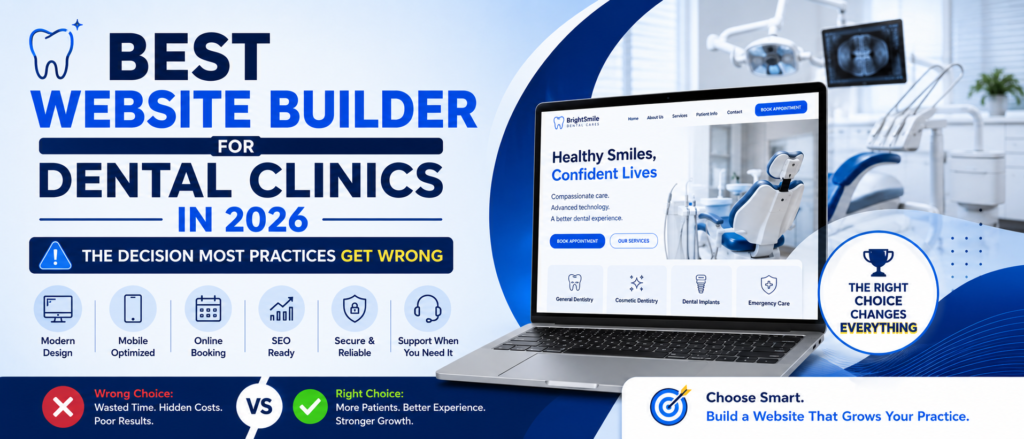
The Best Website Builder for Dental: Most dental practices choose their website builder the wrong way—they pick what looks easiest or cheapest without asking the question that actually determines whether their website generates new patients: Does this platform support specialties and MS-integrated booking without requiring a separate $300/month middleware tool?
Here is the straight answer based on that specific question:
WordPress with SiteGround hosting is the correct choice for the majority of dental practices. It is the only platform that embeds NexHealth and LocalMed without restrictions, gives you complete control over local SEO, and costs under $10/month to run. The learning curve is steeper than Wix or Squarespace — but a dental office manager with zero technical experience can build a professional WordPress dental site in one afternoon using the Astra theme and a guided setup.
Wix is the correct choice for a dental practice that has no PMS integration requirement, wants the fastest possible launch with zero technical involvement, and accepts the SEO ceiling that comes with a closed platform.
ProSites and Officite are the correct choice for established practices with $200-500/month budgets that want a completely hands-off managed solution with dental-specific templates, HIPAA compliance built in, and a vendor who handles everything from content updates to reputation management.
The platforms that are never the right choice for a dental practice: free website builders, GoDaddy Website Builder, and any platform that cannot embed a JavaScript booking widget from your PMS vendor.
The Real Decision Framework Dental Practices Should Use
Generic website builder comparisons evaluate ease of use, template quality, and price per month. Those metrics apply equally to a tattoo artist and a dental practice. They miss the three factors that determine whether a dental website actually generates new patient bookings.
Factor 1 — PMS Booking Integration
Your website builder must be able to embed a JavaScript widget from NexHealth, LocalMed, or your PMS vendor’s native booking tool. This is a non-negotiable requirement for any practice running active online booking.
Generic builders like Wix and Squarespace work for restaurants and retail, but they lack treatment pages, before and after galleries, online booking, and HIPAA-compliant forms that turn dental traffic into new patients.
The specific technical requirement is this: your platform must allow you to paste a custom JavaScript embed code into a page without stripping it or blocking external scripts. WordPress allows this completely. Wix allows it on paid plans with restrictions. Squarespace allows it on the Core plan and above. Free plans on any platform do not support custom JavaScript—meaning free Wix or any free platform is immediately eliminated for a dental practice with PMS booking.
Factor 2 — Local SEO Control
A dental practice competes for local search rankings — not national rankings. The SEO requirements are specific: individual service pages targeting city-level keywords, Google Business Profile schema markup, correct NAP consistency across every page, and the technical ability to configure meta titles and descriptions for every individual page without platform restrictions.
Wix sites went from 55% to 74% of pages achieving good Core Web Vitals scores, according to Web Almanac 2025—a genuine improvement. However, the ceiling is that you cannot go beyond Wix’s predefined SEO controls. There is no equivalent to Rank Math’s advanced features.
For a dental practice competing in a major city where ten practices are all targeting the same “dentist near me” keywords, the difference between WordPress’s granular SEO control and Wix’s predefined limits is a meaningful competitive disadvantage.
Factor 3 — HIPAA Compliance Architecture
As covered in our hosting guide, no mainstream website builder platform signs a Business Associate Agreement. The compliance question is therefore not which platform is HIPAA compliant—none of them are for PHI storage. The question is which platform allows you to correctly route patient data through HIPAA-compliant tools rather than storing it on the platform itself.
WordPress handles this correctly because you can install Jotform HIPAA or Formstack HIPAA for intake forms and embed NexHealth or LocalMed for booking, so no PHI ever touches your WordPress installation. Wix and Squarespace require similar workarounds — their native form builders are not HIPAA compliant for medical history collection.
The Six Best Website Builder for Dental Practices — Honest Comparison
| Platform | Monthly Cost | PMS Booking Integration | HIPAA Forms | SEO Control | Setup Time | Best For |
|---|---|---|---|---|---|---|
| WordPress + SiteGround | $4.99-9.99 | Full NexHealth and LocalMed support | Via Jotform HIPAA plugin | Complete — Rank Math | Half day | Most dental practices |
| Wix Core | $23 | JavaScript embed with iframe restrictions | Not native — workaround needed | Good but ceiling exists | 2 hours | Fast launch — no PMS needed yet |
| Squarespace Core | $23 | JavaScript embed via code injection | Not native — workaround needed | Good but limited vs WordPress | 3-4 hours | Design-focused practices |
| ProSites | $200-400 | Built-in dental scheduling | HIPAA compliant built in | Managed by ProSites team | Handled by vendor | Established practices — hands-off |
| Officite | $300-500 | Full dental PMS integration | HIPAA compliant built in | Fully managed | Handled by vendor | High-revenue hands-off practices |
| GoDaddy Website Builder | $10-25 | No PMS support | No | Very limited | 1-2 hours | Not recommended for dental |
WordPress — The Right Answer For Most Dental Practices
WordPress powers 43% of all websites globally because it solves the fundamental problem every professional website faces: you need a platform that does exactly what your specific business requires, not what a closed platform decides to support.
For a dental practice this means three specific things. First, NexHealth and LocalMed embed without restrictions—you paste the JavaScript code into a custom HTML block, and the booking widget appears exactly as the vendor designed it. Second, Rank Math gives you complete control over every SEO element for every page—meta titles, descriptions, schema markup, local business structured data, and XML sitemaps are all configured precisely for local dental searches. Third, your hosting costs are completely separate from your platform costs—you pay SiteGround $4.99/month, and WordPress is free, rather than paying an all-in-one platform that increases pricing as your practice grows.
WordPress wins on integrations because its business plan unlocks the full WordPress plugin directory, giving it a higher ceiling for third-party tools than either Wix or Squarespace can match through their native app markets.
The honest limitation: WordPress requires more initial setup than Wix or Squarespace. Installing WordPress, configuring the Astra theme, installing four plugins, and building your five core pages take approximately one full afternoon for someone with no prior experience. Wix can have a basic site live in two hours. For most dental practices, that time investment is worth the long-term control and SEO advantage—but for a practice that genuinely has zero time for technical setup, this is a real consideration.
Get SiteGround + WordPress — Our Top Recommendation
Wix — The Right Answer For Speed and Simplicity
Wix is genuinely the easiest website builder available in 2026. The AI site builder generates a full site including layout, content, and images from your prompts, and the 2025 Wix Harmony update adds vibe-coding-style design changes. For speed and completeness of first output, Wix leads across all three platforms tested.
For a dental practice that needs to be online immediately, has no PMS integration requirement yet, and wants to manage the website without any technical involvement, Wix is a legitimate choice. The Wix Bookings feature handles basic appointment scheduling without external integration.
The honest limitations for dental practices are specific. Wix does not support third-party theme installation, and template switching after launch is not possible, which limits design extensibility over time. More critically for dental practices, Wix’s native booking tool does not integrate with Dentrix, Eaglesoft, or any major dental PMS. A practice that starts on Wix with Wix Bookings and later needs real PMS integration faces either migrating to a different platform or paying for an additional middleware tool.
The SEO ceiling is the other honest limitation. Wix has improved significantly — 74% of Wix pages now achieve good Core Web Vitals scores — but the granular SEO control that WordPress provides through Rank Math is not available on Wix. For a practice in a competitive market where local SEO is the primary patient acquisition channel, this limitation has direct revenue implications.
Try Wix — Best For Fast Launch
ProSites — The Right Answer For Established Practices Who Want Zero Involvement
ProSites is the most established dental-specific website platform available. ProSites is trusted by over 7,500 dental practices, has helped dentists create their ideal websites, and specializes in custom solutions for various dental specialties, including orthodontics, periodontics, general dentistry, and more. They focus on functionality with features like digital forms, online scheduling, and automatic appointment reminders.
The honest value proposition is this: ProSites handles everything. Templates are designed specifically for dental patient journeys. HIPAA-compliant forms are built in. Practice management system integrations are handled by their technical team. SEO is managed by dental marketing specialists rather than requiring you to learn Rank Math.
The downside is cost and flexibility. ProSites typically requires contracts, and monthly fees range from $200 to $400. Their template designs, while functional, can feel dated compared to modern alternatives.
For a high-revenue established practice where the dentist’s time is worth significantly more than the cost differential between ProSites and WordPress, ProSites represents a legitimate investment. For a new practice or a practice with a budget-conscious office manager who is willing to spend one afternoon on setup, the $200-400/month ProSites fee delivers less value than WordPress at $5/month with equivalent functionality.
See ProSites Plans
Officite—The Right Answer For Hands-Off Premium Management
Officite specializes in websites for healthcare practices, including dental offices. Owned by Internet Brands, they offer a comprehensive suite of services, including reputation management, social media posting, and SEO, alongside their website platform. For dental practices wanting a completely hands-off approach, Officite handles everything from content creation to ongoing optimization. Their HIPAA-compliant forms and dental industry templates cover the essential bases. Premium pricing of $300-500/month reflects the managed service model.
Officite is the most expensive option reviewed here. The cost is justified specifically for practices that have no internal capacity to manage any aspect of their digital presence — a solo practitioner managing a busy clinical schedule with minimal administrative support who needs everything handled externally.
For practices with an office manager who can spend two hours per month on website maintenance, WordPress with SiteGround delivers equivalent functionality at a fraction of the cost.
See Office Plans
The Decision Matrix — Which Platform For Which Dental Practice
New practice launching first website with tight budget and some technical willingness: WordPress with SiteGround at under $10/month. One afternoon setup. Full NexHealth and LocalMed compatibility. Complete SEO control.
Established single-location practice wanting fastest launch with zero technical involvement: Wix Core plan at $23/month. Live in two hours. Accept the SEO ceiling and plan for PMS integration via JavaScript embed on the paid plan.
Established practice wanting dental-specific templates with HIPAA compliance and some managed services: ProSites at $200-400/month. Proven platform, dental-specific, handles integration.
High-revenue practice or group practice wanting a completely hands-off managed digital presence: office rent at $300-500/month. Everything is managed externally, including content, SEO, and reputation.
What Office Managers In Dental Communities Actually Say About This Decision
The website builder debate appears regularly in the Dental Office Managers Facebook group and on Dentaltown forums. The consistent pattern across hundreds of threads shows three recurring situations.
Practices that started on Wix and grew report the most migration headaches — specifically when they added NexHealth or LocalMed and discovered their Wix template was restricting the booking widget display. The migration to WordPress typically takes one weekend, and the common sentiment is wishing they had started on WordPress initially.
Practices that pay ProSites or Officite retainers report the highest satisfaction when they genuinely have zero time for website management and the lowest satisfaction when they realize they are paying $300/month for a website that a WordPress setup at $5/month would replicate with equivalent patient-facing functionality.
Practices that built their own WordPress sites with Astra report the steepest learning curve in week one and the highest long-term satisfaction — specifically because every SEO change, content update, and booking integration works exactly as intended without platform restrictions or support ticket delays.
These questions came directly from the dental office managers’ Facebook group and Dentaltown forums—real decisions real office managers are making right now.
Frequently Asked Questions From Dental Office Managers
Can I switch from Wix to WordPress without losing my Google rankings?
Yes — with careful redirect management. Every URL on your Wix site needs a 301 redirect pointing to the equivalent WordPress URL. This tells Google that your pages have permanently moved and transfers your existing ranking authority to the new URLs. SiteGround’s migration team handles the technical transfer. You set up the redirects in WordPress using the Redirection plugin. Rankings typically recover within 4-8 weeks if redirects are implemented correctly. Practices that switch without proper redirects lose their rankings entirely — this is the primary risk in any website platform migration.
Does Wix work with NexHealth?
Yes, on paid plans—but with a specific configuration requirement. NexHealth provides a JavaScript embed code. In Wix you add this via the Wix HTML iframe element in the editor. The booking widget displays correctly but sits inside an iframe container rather than embedding natively into the page. Some NexHealth features, including certain confirmation flow elements, behave differently inside Wix’s iframe than they do on a native WordPress embed. For a practice using NexHealth’s full feature set, WordPress provides cleaner integration.
Is ProSites worth the cost for a new practice?
For a new practice — no. ProSites’ value is in their managed services and established dental SEO expertise. A new practice with a zero existing online presence gains the same initial SEO foundation from a correctly configured WordPress site with Rank Math at $5/month that ProSites provides at $200-400/month. The ProSites premium makes sense when you are paying for ongoing management of an established digital presence — not for initial website setup.
Can I use Squarespace for a dental practice?
Squarespace Core at $23/month is where most users actually land. You get unlimited contributors, advanced analytics, no online store transaction fees, and code injection, which unlocks the entire Squarespace plugins ecosystem. Code injection on the Core plan means you can embed NexHealth and LocalMed correctly. Squarespace’s design quality is genuinely superior to Wix’s—cleaner templates, better typography, and more consistent mobile rendering. The honest limitation is the same as Wix—SEO granularity does not match WordPress. For a design-focused practice where brand presentation is the priority and local SEO competition is moderate, Squarespace Core is a legitimate alternative to WordPress.
Note: This comparison focuses specifically on what dental practices need from a website builder — not general small business needs. A platform that works perfectly for a restaurant may be entirely wrong for a dental practice running active PMS booking.